Finland sits in a fascinating place when it comes to digital sovereignty. Its geography means it can’t ignore the power dynamics and risks affecting our world. Its recent history shows that it can be the home to major shapers of technology, but that they don’t necessarily last. Its recent political statements recognise that it needs to ensure that political leadership and clear roadmaps are needed to focus on sovereignty for themselves and as part of Europe. Their security agencies have correctly pointed out that there are limited options for key components of the digital supply chain.
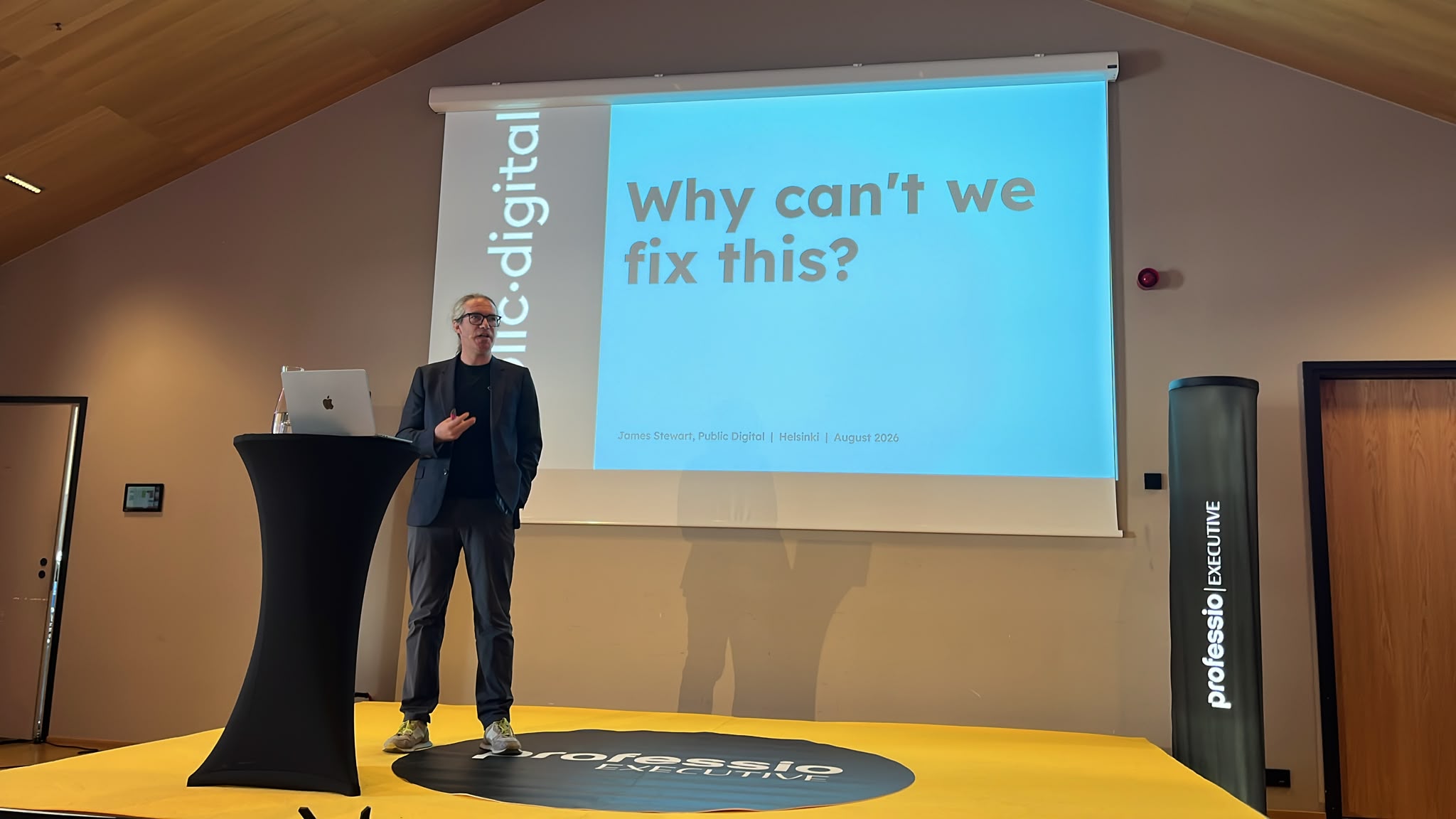
All of which mean it was a real privilege to be asked to provide a keynote address at the 2026 GovTech summit, Helsinki. In the run up to the launch of Digital Sovereignty: The Power To Decide I laid out our contention that while digital sovereignty is often a discussion of big themes, it is often ceded through small decisions that lead to a growing inertia.
I used a reflection on the UK government “Cloud First” policy and my own role in it between 2011 and 2017 to work through the nuances of decision making. We made a conscious decision to move toward public cloud as a route to achieve faster delivery, greater resilience and more modern security practices. I’d still stand by those decisions.
We made those decisions based on a new foundation of skills (to make nuanced architectural decisions and favour standardised building blocks), and a service and commercial approach that let us keep decisions local. That approach was always in tension with a commercial logic that favours “economies of scale” over service outcomes or careful management of the cost of change, but at the time there was sufficient momentum to manage that tension.
The point was that navigating these things is not straightforward and is not a one-time decision. They require a continual commitment of capacity in order to maintain agency. It is vital to both make choices and to remember why you made them if you want to create a foundation for future agency, and make effective use of your current and future capacity.
From there, I offered some models of how different governments have made very different choices, in this case around their next steps on payments. India and Brazil needed to focus on driving inclusion and reducing cost in their overall payment systems and created UPI and Pix. The UK needed to reduce friction in making payments for public services (and reduce the cost of public services taking those payments) and developed GOV.UK Pay.
In all three cases, capabilities were built that created more options for the future. The key was to find a point of need, decide how to apply the right mix of (to use Mike’s formulation) products, platforms and protocols to unlock new solutions to that need, and to learn from the experience.
It was great to get a chance to test some of the themes from the book with a new audience, one faced with familiar challenges in a distinct context. Thanks to the people at Professio Group for the invitation.
(Photo courtesy of Elisabeth Stewart)