
Most large organizations are trapped by their own software—stuck between rigid “best practices” and a tangled mess of over-customization. That’s felt keenly but not uniquely in the world of public finance. Two years ago in DC, Lauren Kahn, Cathal Long and I started a conversation about how to break this cycle and create tools that actually adapt to our needs.
Our new paper, “Better software options for public financial management: Some ideas on where to start.” offers a set of conceptual shifts and practical steps that organisations can take to start breaking out.
The focus for the paper is public financial management, but underneath it the real focus is on how to (re)shape software markets so that the solutions they provide better meet current needs, and adapt to emerging demands and opportunities.
Better software options, in general
The presentation and the paper centred around two models.
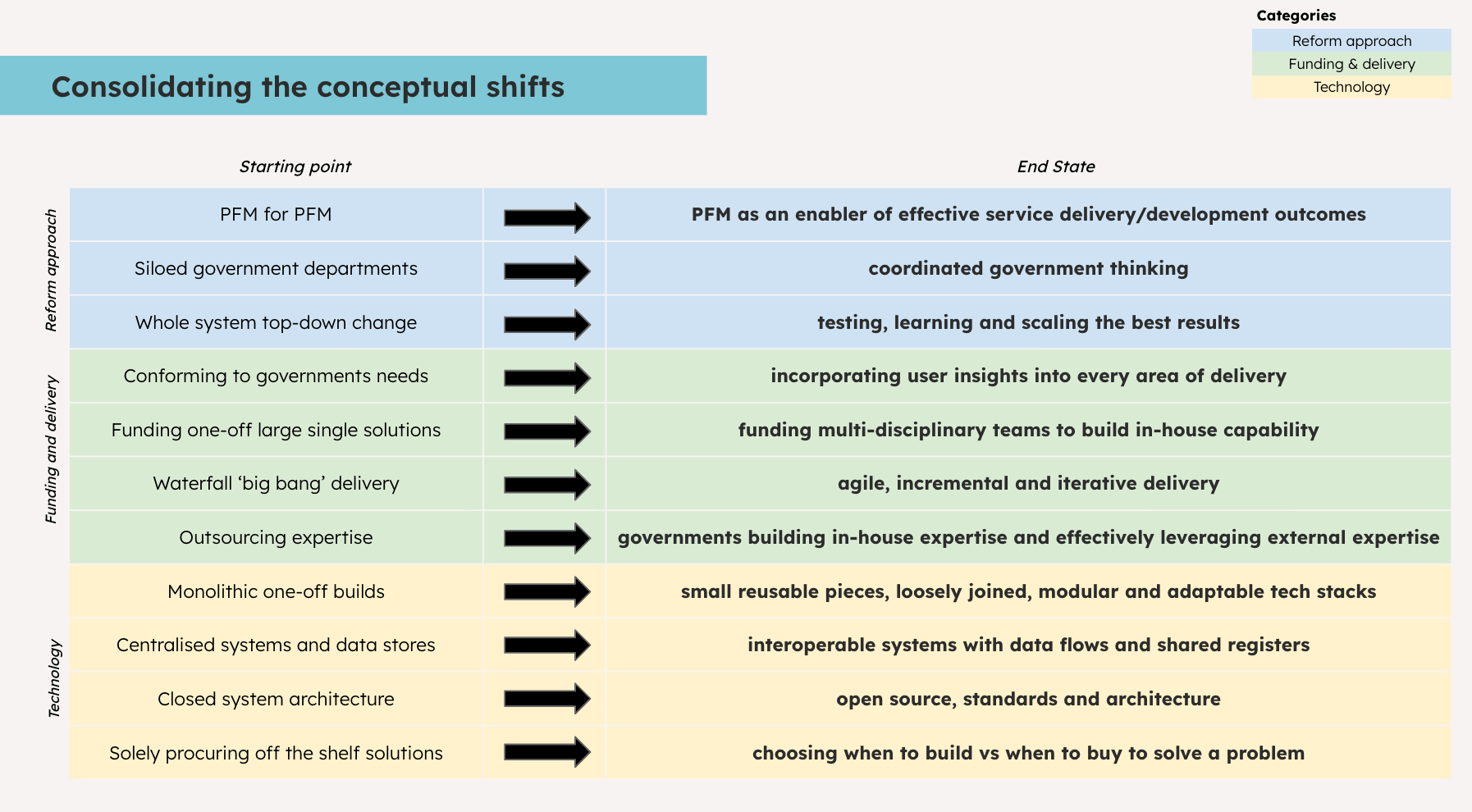
The first lays out a set of “conceptual shifts” from a status quo characterised by traditional IT practices and self-reinforcing practices to a more open, service-oriented and flexible state. Most of these shifts mirror practices that have happened or are happening across industries over the past few decades. Take out language of “PFM” and “finance ministry” and you get the changes that face any business unit supporting a complex organisation.
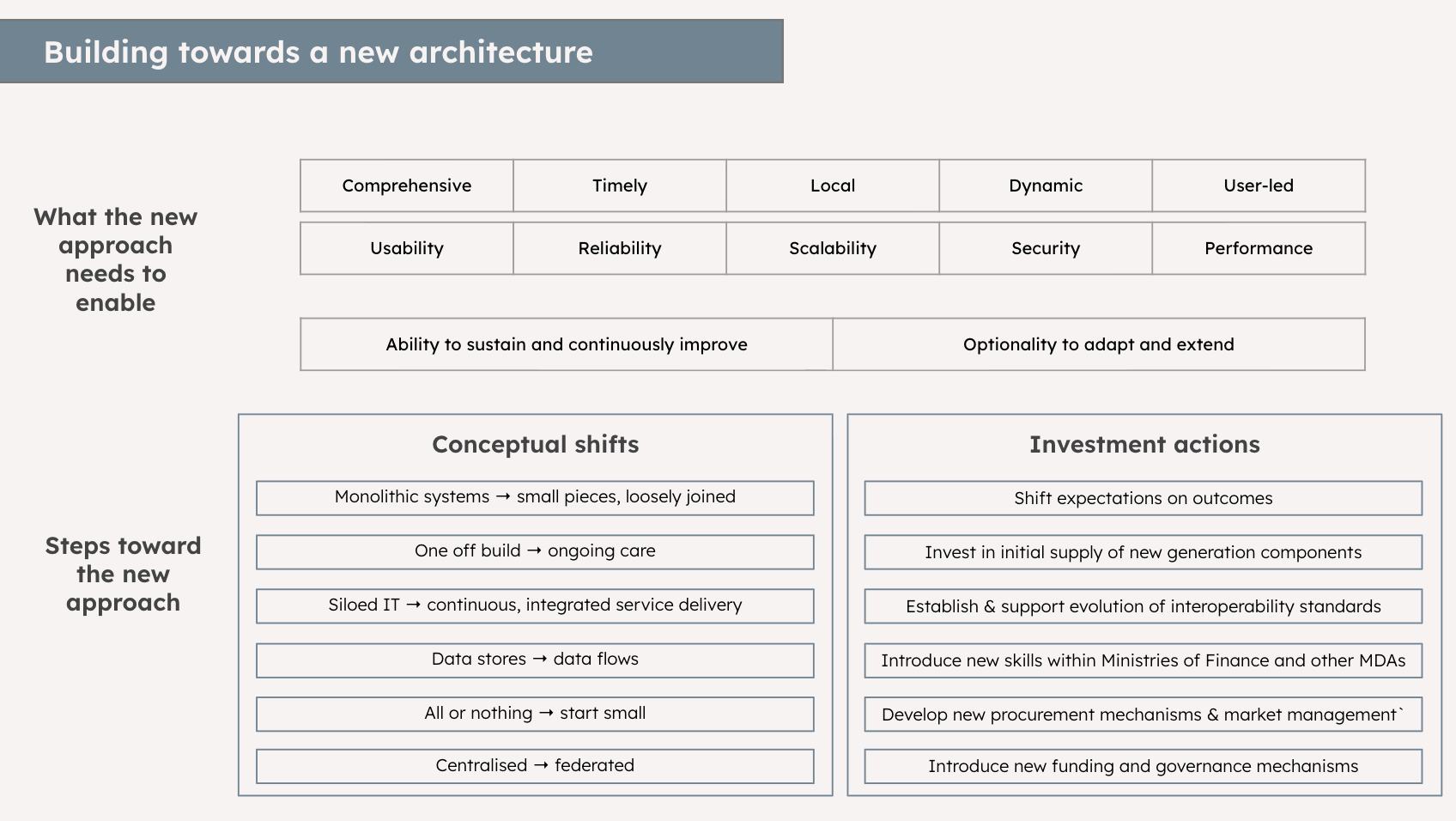
The second lays out those same shifts, but places them alongside a set of broad outcomes and, crucially, investments that enable these outcomes and shifts. Again, take out the language of “ministry of finance” and add in some more grounded, specific outcomes and you get a more broadly applicable view.
That’s not surprising, because many corporate functions have allowed themselves to be constricted by an environment where digitisation is desirable but the tools to do it create enormous constraints. Either limiting you to a tightly-defined ‘best practice’ or allowing so much customisation that you end up with a total mess. Very rarely is there a comfortable balance between them. And that’s largely because the right people haven’t come together in the right way to chart a different course.
The diminishing cost of software development
It’s noteworthy that given the moment in time we wrote the paper Generative AI doesn’t achieve a mention. If we wrote it now then the surging narrative of “the cost of software dropping to zero” would be a strong theme.
But despite that major shift in the software conversation, the principles here still feel sound. An underpinning assumption for us writing the paper is that the past couple of decades have seen our technology options improve in a way that allows for safe, regular evolution of software (continuous delivery) and for deep collaboration between experts of different disciplines.
Code generation with large language models accelerates both of those. The cost of building a specialised tool to solve a specialised need has reduced, but it’ll only work well if we have guardrails like data standards and clear reference data, interoperability standards and appropriate APIs, and most importantly experts in the topic at hand and in how to test software well.
More than that, it emphasises the importance of the team structures to steward the work. We may see a flurry of innovation and process improvements unlocked. We may see the acceleration of technical debt, digital clutter and complexity. We’ll probably see some of both, and both could be productive if approached in the right way. That right way starts with clear outcomes and the right teams.
The sovereignty case
The other theme that we’d include today is that of digital sovereignty. Digital sovereignty is the agency and capacity of any organisation to make intelligent, informed choices to shape its digital future by design.
Mike’s recent piece on Products, platforms, protocols: 3 steps to digital sovereignty comes from a similar place and touches on similar themes.
There’s little that’s more core to an organisation’s sense of sovereignty than how it manages its finances: it wants to build on (and help shape) common practices, but it can’t be beholden in the long term to outside forces (including software vendors) for how it understands its landscape or directs its resources.
There’s more to say on that in due course, but it’s reassuring as an author to see that many of the principles and recommendations of the paper also feel like a route to greater digital sovereignty as well as just better software options.
Ultimately, whether we’re talking about a Ministry of Finance or a global corporation, the goal is the same: software that serves the mission, rather than the mission serving the software. That won’t happen by chance, but requires active market shaping. You can read the full paper on the ODI website, and I’d love to hear from anyone grappling with these same challenges and opportunities.